

Standard industry classifications can obscure retail realities.
Precise NAICS assignments and anchor store tracking provide a clearer picture of center stability and long-term performance trends.
In the fast-paced world of retail real estate, having access to data isn’t enough—you need the right kind of data. To make informed decisions about leasing, acquisitions, or market analysis, professionals need a clear, accurate picture of the physical retail environment.
At ShoppingCenters.com, the Directory of Major Malls (DMM) dataset is uniquely structured to provide actionable, reality-based insights. Two of the most powerful tools in our methodology are our customized approach to NAICS codes and our deep-dive Anchor Metrics. Here is how they work together to provide an unparalleled view of shopping center health.
The Power of “Front-Facing” NAICS Codes
Standard industry classifications can often be misleading in a retail context. If a clothing brand is owned by a multinational holding company, categorizing that store under “Offices of Other Holding Companies” tells you nothing about the actual storefront.
To solve this, the DMM methodology utilizes “Front-Facing” NAICS codes to align with the retail category of the specific brand, rather than the broader corporate or industry category of the parent company.
Incorporating over 660 distinct NAICS codes that directly relate to 375k associated DMM tenants, this comprehensive structure enables users to pinpoint specific tenant types by their standardized code rather than relying on inefficient, manual filtering by brand name.
The granularity this provides is exceptional. Consider the Food & Restaurant category alone. Rather than grouping all dining concepts under a single broad label, the DMM assigns more precise NAICS codes that reflect the actual consumer experience:
- Limited-Service Restaurants — such as Sonic, McDonald’s, and Burger King
- Full-Service Restaurants — such as Johnny Rockets, PF Chang’s, and The Cheesecake Factory
- Snack and Nonalcoholic Beverage Bars — such as Häagen-Dazs, Coffee Beanery, and Starbucks
This level of specificity means an analyst can instantly distinguish between a quick-service drive-through corridor and a full-service dining destination—without ever filtering by individual brand name.
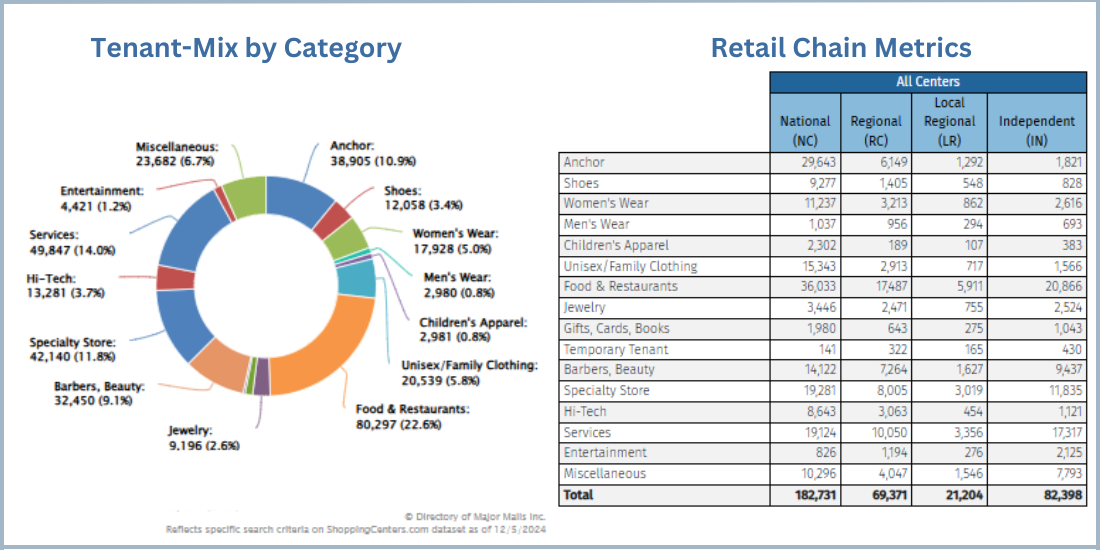
Going Beyond Broad DMM Categories
Several core DMM categories—including Anchors, Services, and Miscellaneous—encompass an extraordinarily wide range of tenant types. Without NAICS code granularity, these broad buckets can obscure meaningful differences in tenant mix. The front-facing NAICS codes assigned within each category bring immediate clarity.
Anchor Stores
Anchor tenants are defined by their role as a major traffic-driving component of a shopping center, but the type of anchor varies significantly—especially in large open-air centers and grocery-anchored community centers, where the traditional department store anchor is often absent. DMM’s NAICS assignments allow analysts to immediately identify the nature of an anchor, including:
- Grocery — Wegmans, Safeway, Super Walmart
- Department Store — Zellers, Macy’s, Neiman Marcus, Nordstrom
- Pet Supplies — Petco, Petland, PetSmart
- Office Supply — OfficeMax, Staples
- Fitness — Planet Fitness, 24 Hour Fitness, Gold’s Gym
Without NAICS code differentiation, a vacant anchor space formerly occupied by a grocery store would appear identical in the data to one left by a department store—two scenarios with vastly different repositioning implications and replacement tenant strategies.
With front-facing NAICS codes, analysts can filter by tenant category across an entire region and cross-reference vacant anchor indicators to quickly identify at-risk centers, no brand-by-brand searching required. The result: faster, more accurate vulnerability screening across large portfolios.
You’ll want to find Levis stores coded as “448140- Family Clothing Stores” and not “315250 – Cut and Sew Apparel Manufacturing.
Service Tenants
The Service category covers a broad spectrum of tenant activity, all of which carry more specific NAICS codes that reflect the precise nature of the business:
- Medical — Walk-in clinics, dental offices, chiropractors
- Banking & Credit Unions
- Insurance Providers
- Shipping Services — UPS, FedEx, US Postal Service
Miscellaneous Tenants
The Miscellaneous category captures tenants that fall outside traditional retail classifications but play important roles in a center’s ecosystem:
- Academic institutions
- Liquor and wine stores
- Fuel stations
- Thrift and resale (e.g., Goodwill)
- Dollar stores
- Auto dealerships
By assigning precise NAICS codes to each of these tenant types, DMM transforms what would otherwise be an opaque “miscellaneous” bucket into a fully searchable, filterable, and analytically rich dataset.
For example, an analyst looking to identify all grocery anchor tenants or financial institutions across a region can simply filter by the NAICS codes for “Supermarkets and Other Grocery Stores” or “Commercial Banking.” This completely bypasses the need to individually search for hundreds of disparate brand names like Kroger, Safeway, Chase, or Bank of America, saving time and ensuring no local or regional brands slip through the cracks.
Bringing it Together for Comprehensive Analysis
The true power of the DMM dataset is realized when these methodologies are combined. By utilizing front-facing NAICS codes, stakeholders can understand exactly what type of anchor is driving foot traffic or leaving a void—distinguishing between a grocery anchor, a big-box sporting goods store, or a traditional department store.
When you apply this precise categorization to our robust Anchor Status identification, you move beyond raw data. You gain a clear, actionable picture of a center’s tenant mix, its immediate vulnerabilities, and its long-term trajectory in the market.
Ready to elevate your retail real estate analysis? Discover the most accurate, comprehensive shopping center and retail data available at ShoppingCenters.com.
Speak to a DMM Data Expert
Related Articles: