
Despite economic headwinds, U.S. retailers are still opening thousands of stores annually—but the strategy has fundamentally shifted from volume-driven growth to data-informed, risk-conscious site selection, where location quality, total occupancy costs, and supply chain logistics now outweigh the simple desire to expand
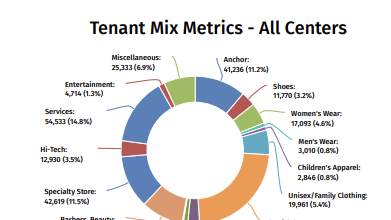
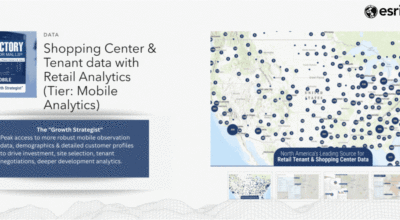
The July 2026 dataset from [Directory of Major Malls / ShoppingCenters.com](https://shoppingcenters.com/) provides verified intelligence on 17,636 North American retail properties and 369,709 active tenant locations. Built for B2B commercial real estate, it integrates with GIS and demographic platforms to optimize site selection, leasing, and underwriting workflows.
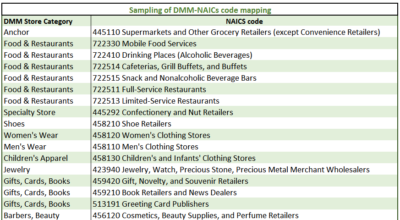
You’ll want to find LEVIS coded as “448140- Family Clothing Stores” and not “315250 – Cut and Sew Apparel Manufacturing.
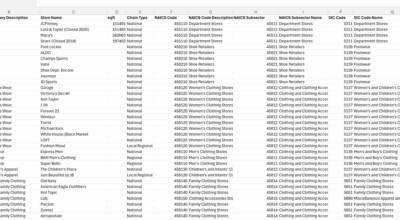
Standard industry codes often misclassify retail stores under their parent company’s category. DMM solves this with 660+ “Front-Facing” NAICS codes that reflect the actual storefront brand—making it easy to find specific tenant types without filtering by brand name.”
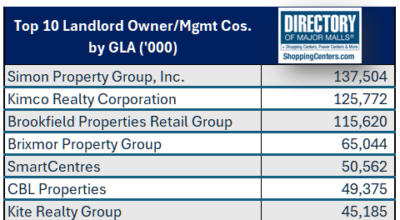
The January 2026 dataset from Directory of Major Malls / ShoppingCenters.com provides extensive coverage of shopping center landlords, REITs, and management companies across the U.S. and Canada. Comprehensive property details, complete tenant/store lists, Anchor store metrics, demographics, trade area demographics, cross-shopping and more.
Specialty leasing has transformed from a stopgap solution into a core strategic driver for retail properties, fueled by shifts in consumer behavior, brand experimentation, and the rise of experiential activations. Today’s flexible retail model emphasizes proactive planning, digital lead generation, integrated leasing teams, and technology-enabled operations.
Retailers use short-term spaces to test markets and concepts, while owners leverage pop-ups, touring exhibits, and community-focused experiences to generate foot traffic and diversify revenue. As the discipline matures, specialty leasing is becoming a sophisticated, data-informed engine shaping the future of shopping centers.
Educate and network at the www.FlexRetailSummit.com
Shopping center landlords face unique challenges managing Common Area Maintenance (CAM) charges and reconciliations. This comprehensive guide explores proven strategies for streamlining CAM processes, reducing tenant disputes, and maintaining transparent communication that strengthens landlord-tenant relationships while optimizing property performance.
The January 2026 dataset from Directory of Major Malls / ShoppingCenters.com provides extensive coverage of shopping center landlords, REITs, and management companies across the U.S. and Canada. Comprehensive property details, complete tenant/store lists, Anchor store metrics, demographics, trade area demographics, cross-shopping and more.
November 2025 release notes 🛍️ 17,399 shopping centers & 364,924 tenant locations Explore the North American retail shopping center landscape with the extensive Directory of Major Malls / ShoppingCenters.com dataset which […]
Discover the North American retail shopping center landscape like never before! Welcome to the May 2025 release notes for the Directory of Major Malls / ShoppingCenters.com dataset, which features a wide range of shopping center classifications across the U.S. and Canada.
The Directory of Major Malls (DMM) has partnered with Esri to deliver access to 364,000 tenants with over 106,000 retail brands across 17,000+ US and Canadian shopping centers as a feature service on the Esri ArcGIS platform.
This integration includes sophisticated trade area analytics derived from mobile device activity, providing detailed consumer profile demographics, segmentation, and cross-shopping metrics at the zip+4 and census block group levels.
Q2-2024 Mobile metrics for U.S. major shopping centers and malls are now available from DMM / ShoppingCenters.com.
Notable mobile activity shifts this quarter: Top 10 increases for mobile activity by Qtr. range 71% to 199% ;
Biggest decrease in mobile activity by Qtr: range -25% to -34%; Average miles traveled to center by a visitor: 11.35
Directory of Major Malls offers delineated Shopping Center Geofences (polygons) for almost 20k major shopping centers and malls in the United States and Canada. These proprietary polygons, created through a strategic alliance with B I Spatial.
DMM geofences are very robust and flexible. The polygons can be combined seamlessly with the DMM full dataset as well as mobile and segmentation data and they can be visualized in any Geospatial Platform chosen. This union allows real estate teams, retail brands and business analysts to derive additional insights on customers and the DMM shopping center.