
A placemaking perspective on the built environment’s next twenty years
For a decade and a half, the question “Can physical space survive the internet?” has been asked as though it were still open. It isn’t. Brick-and-mortar retail already had this fight — and won it, not by beating e-commerce, but by becoming something e-commerce cannot be. The more urgent version of the question today isn’t about shopping at all. It’s about work, and about what happens to commercial real estate when “going to work” stops meaning going anywhere.
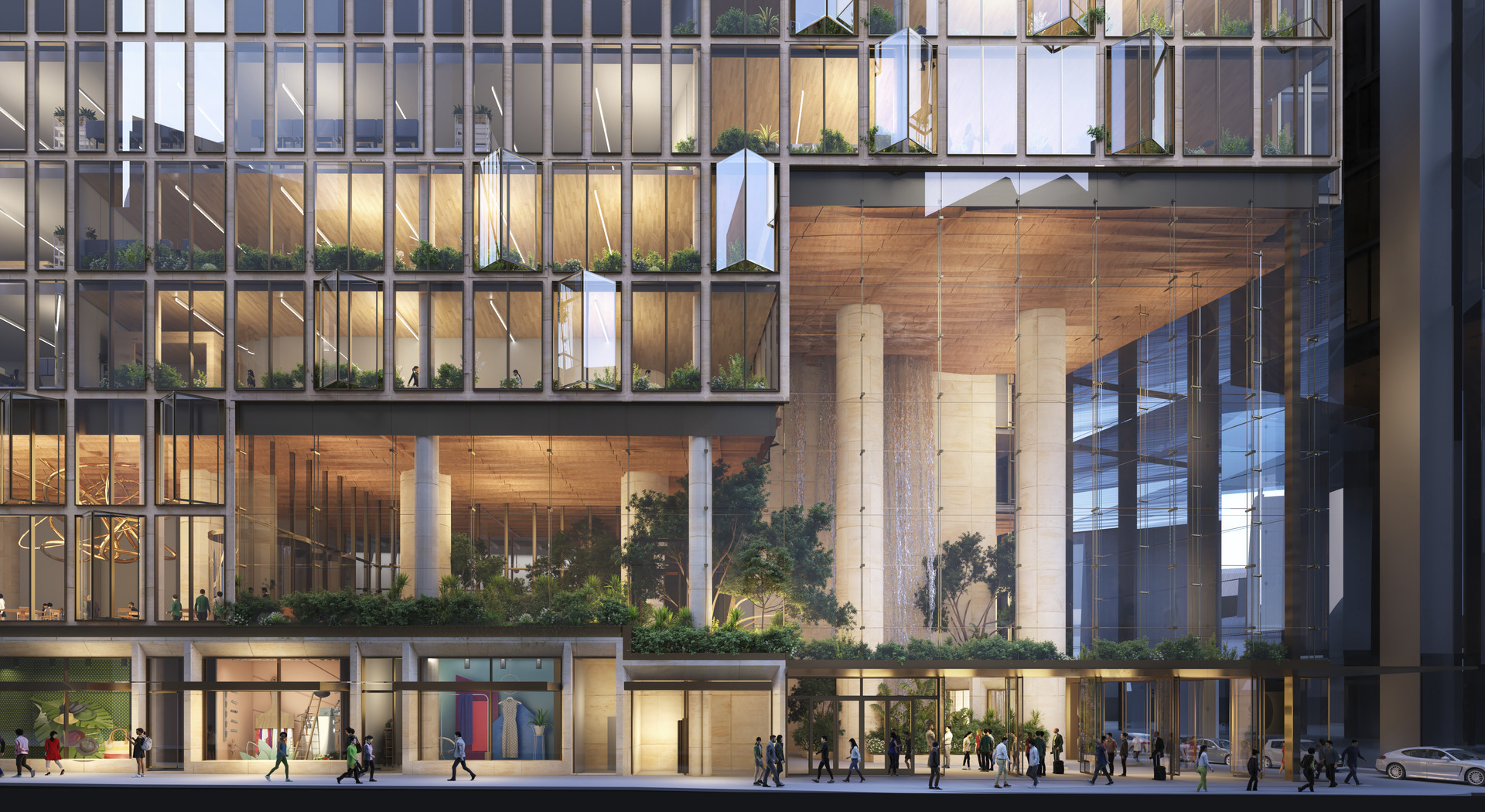
Both questions have the same answer: placemaking. Not the decorative version—banners, benches, and a flashy events calendar—but the deliberate design of human experience in physical space. The discipline now faces its hardest chapter: designing places around robots, sensors, and algorithms, as well as people. Human-centered design must balance two new realities—prioritizing the human experience while acknowledging that fewer people may be on-site. That tension, rather than e-commerce or remote work, is the real issue asset owners need to understand and react at pace.
Placemaking, as a discipline, has long been defined as a multi-disciplinary approach to the planning, design, and management of physical space, emphasizing community needs and engagement to create environments that are more meaningful, functional, and genuinely attractive to be in. For two decades, the built environment has been managed as though the structure were the asset and the people were incidental. The data below suggests the opposite has been true the whole time, in both retail and office real estate, and that the owners who recognize it first will be the ones who keep their buildings full.
E-Commerce Isn’t the Disruption — Retail Already Survived It
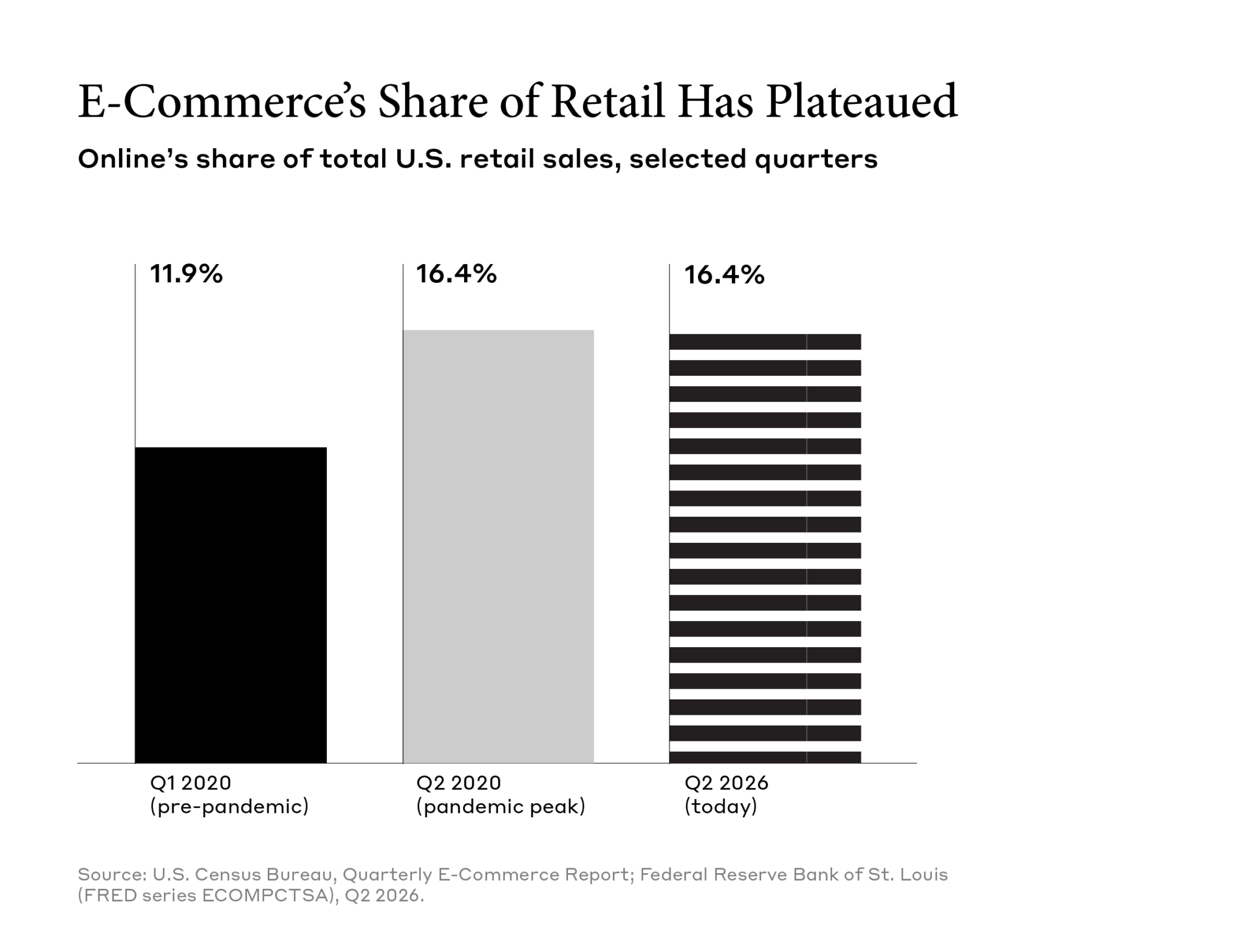
Retail has spent twenty years absorbing the “Amazon will kill the mall” narrative, and the data no longer supports it. E-commerce’s share of total U.S. retail sales sits at 16.4% as of the most recent quarter — statistically unchanged from its pandemic peak in mid-2020, and only modestly above the 11.9% it held just before COVID hit (Figure 1).[1] Online shopping did what it was always going to do: it captured a real, durable slice of transactional retail — commodity goods, replenishment purchases, price-comparable items — and then it plateaued. Eighty-four cents of every retail dollar in America is still spent in a physical location.
[1]U.S. Census Bureau, Quarterly E-Commerce Report; Federal Reserve Bank of St. Louis, FRED series ECOMPCTSA, Q2 2026.
Can Physical space survive the internet?
That plateau is the tell. If e-commerce were still disrupting brick-and-mortar the way the narrative claims, its share would still be climbing. It isn’t, because the two channels were never actually competing for the same job. E-commerce won the transaction. Physical retail is winning something e-commerce structurally hasn’t been able deliver: experience, presence, and the increasingly rare currency of a person’s undivided attention. In the presence, of other humans. But that’s not to say that won’t change. As digital experiences become increasingly “more human” the 5 senses activated by physical interaction will still tug at the most compelling of our social instincts – gregariousness (preferring not to be alone, enjoying company). This is where physical brick and mortar can, and does lead the retail race.
This is not a post-pandemic pivot — it is a twenty-year arc. Since the early 2000s, the most resilient physical retail formats have been the ones that stopped competing on convenience and started competing on why anyone would bother leaving the house. Food and beverage, entertainment, fitness, personal services, and experience-anchored anchors have steadily displaced pure merchandise as the leasing story at well-run centers.
Placer.ai’s 2025 shopper-behavior data shows exactly this shift happening in real time: at indoor malls, 37.6% of visits now last 75 minutes or longer, with open-air centers (33.4%) and outlet centers (34.6%) close behind — even as short, transactional visits under 30 minutes also grew across every format (Figure 2).[2] Retail is bifurcating into quick-utility trips and long, immersive ones, and it is the long visits — the ones built on food, live events, third-place seating, and reasons to linger — that are pulling foot traffic and dwell time upward.
[2]Placer.ai, “How Malls Can Win in 2026,” 2026.

What’s emerging is not physical retail versus digital retail. It’s hybrid consumption: a single customer journey that moves fluidly between a phone, a screen, and a storefront, with no clean line between which “channel” gets credit for the sale. Buy-online-pickup-in-store, livestream shopping tied to a physical activation, augmented-reality fitting integrated into the store visit, loyalty apps that unlock in-store experiences — these aren’t retailers hedging between physical and digital. They are physical and digital operating as one system, in equal measure, because that’s how the customer actually behaves.
The placemaking implication is direct: a shopping center is no longer just leasing square footage to tenants. It is designing a physical stage for a consumption journey that is already half-digital before the customer ever parks the car. Centers that understand this — investing in experience anchors, flexible event space, and seamless digital integration — are the ones converting foot traffic into dwell time and dwell time into revenue per square foot. Centers still merchandised purely as transaction machines are the ones losing tenants, not because e-commerce took their sales, but because they never gave anyone a reason to stay.
The Real Structural Risk Is in the Office, Not the Storefront
If retail has already adapted, commercial office has not — and the data suggests it may not get the chance to return to its pre-pandemic form at all. National office vacancy has climbed from roughly 17.0% at the onset of the pandemic to 20.6% as of the second quarter of 2025, the sixth consecutive quarterly high, according to Moody’s Analytics (Figure 3). [3] Return-to-office mandates have done little to reverse it: even federal agencies have been net shedders of office space, with the U.S. government alone giving up 850,000 square feet in Washington, D.C. in the first half of the year.[4] This is not a temporary vacancy cycle waiting for a normal business cycle to correct it. It is a structural repricing of how much physical office space the economy actually needs.
[3] Moody’s Analytics Q2 2025 office data and [4] CBRE data on U.S. federal office space reductions, cited in CRE Daily, “Office Vacancy Hits 20.6% in US as Leasing Demand Slumps,” July 3, 2025.

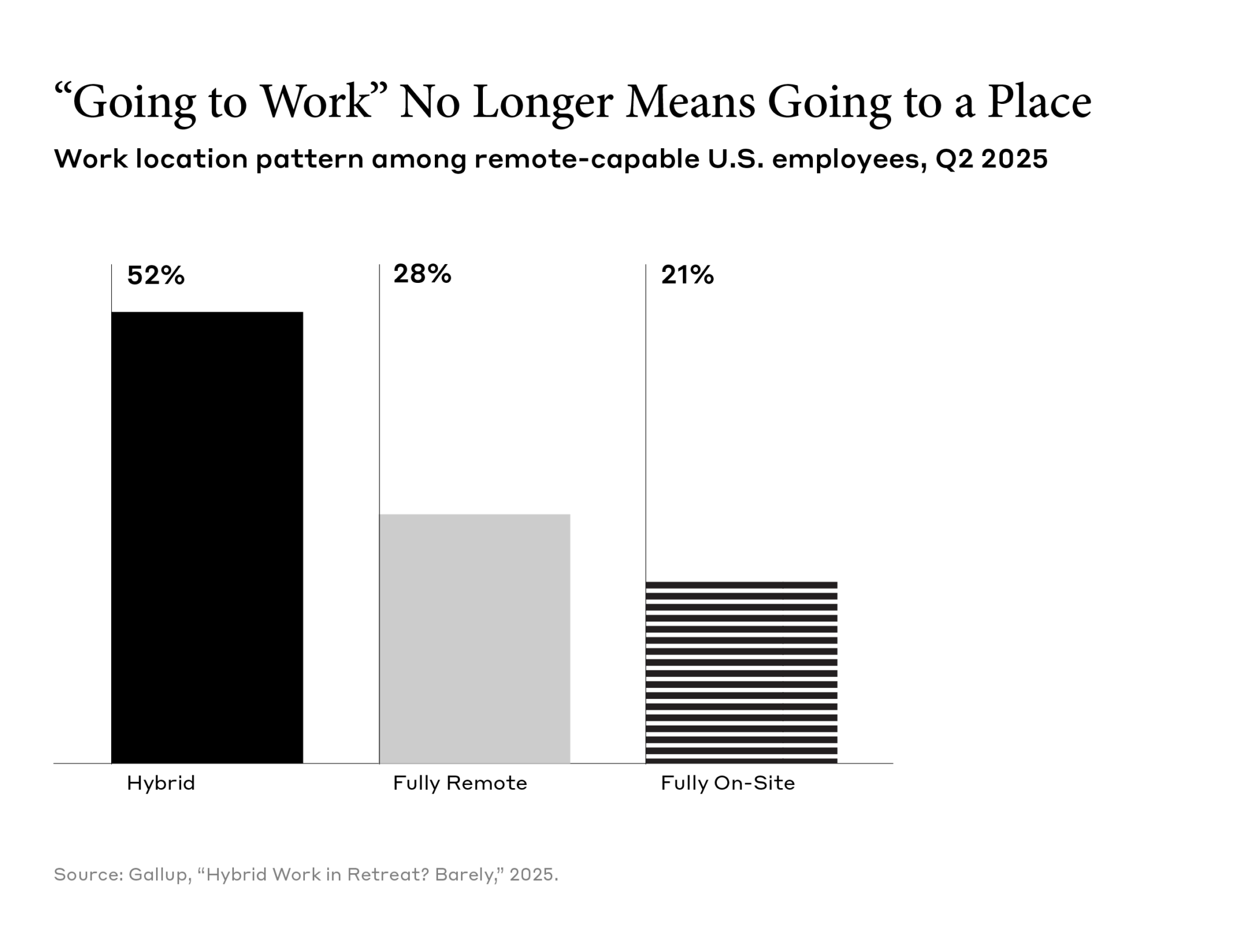
The reason is not simply “people don’t want to commute.” It’s that the underlying unit of work has changed. Among remote-capable U.S. employees, only 21% now work fully on-site; 52% work hybrid and 28% work fully remote, according to Gallup’s most recent measurement — a pattern Gallup itself describes as stabilized, not retreating (Figure 4).[5] Layer onto that the accelerating deployment of AI copilots for knowledge work and robotics and automation for physical and logistics work, and the entire premise of the office — that value is created by bodies co-located in a building — is being hollowed out from both the white-collar and blue-collar sides at once. “Going to work” for a growing share of the workforce now literally means opening a laptop. It does not mean commuting to a place.
[5]Gallup, “Hybrid Work in Retreat? Barely,” 2025.
This should concern every owner of commercial real estate adjacent to office density, including retail landlords whose daytime foot traffic has historically depended on office workers grabbing lunch, running errands, or stopping at a gym on the way home. But the deeper lesson isn’t defensive — it’s the same lesson retail already learned. Asset owners and corporations that treat “the office” as a mandatory container for labor will keep losing the argument to a laptop. The ones that treat the workplace as a place people choose to be — because it offers something a kitchen table cannot — will remain relevant, and will continue to drive real value out of the square footage they own.
Gen Z becomes the pivot point
That is where Gen Z becomes the pivot point, not a footnote. This is the first generation of workers who have never known an economy where physical presence was the default, and their loyalty behaves accordingly. Deloitte’s 2026 Gen Z and Millennial survey finds this cohort prioritizing long-term fit and personal sustainability over the fast-track career ladder — just 25% of Gen Z say they want rapid, fast-paced promotion.[6] Independent brand-loyalty research reinforces the same pattern from the consumer side: fewer than 5% of the country’s most visible brands show up consistently across the full range of ways Gen Z engages with them, with more than half appearing in only one context at all.[7] Read together, the signal is consistent: this generation is not loyal to the biggest name, the biggest paycheck, or the most prestigious address. They are loyal to the quality of their day-to-day experience — and that loyalty is portable. It follows the experience, not the institution, whether the institution is an employer or a retailer.
The Placemaking Answer: Designing Human Experience Into Increasingly Inhuman Spaces
Here is the paradox asset owners now have to design around. The most valuable commercial real estate of the next two decades will need to feel more human than ever — more textured, more social, more emotionally resonant — at the exact moment that the humans required to run it are disappearing from the floor plan. Warehouses are being built for robotic fulfillment, not foot traffic. Back offices are being automated by AI systems that need server racks and cooling infrastructure, not desks and break rooms. Even physical retail is quietly reducing headcount per square foot through self-checkout, computer vision, and automated inventory. Placemaking in the 21st century is not just about people using space — it’s increasingly about designing for a mix of humans, data infrastructure, and autonomous systems that occupy the same buildings for entirely different reasons.
Human-centered design needs to evolve accordingly. It can no longer assume that “more human activity” is the automatic goal of every square foot. Instead, the discipline needs to get precise about where human experience is the product — the food hall, the plaza, the collaborative office floor, the wellness center, the third place — and design those zones with more intention than ever, while allowing the automated, data-driven, low-human-capital zones to be genuinely optimized for what they’re for. A shopping center’s back-of-house logistics doesn’t need to feel human. Its center court absolutely does. An office building’s server floor doesn’t need soul. Its collaboration floor is the entire reason anyone still commutes in.
The the practical takeaway is this: brick-and-mortar isn’t fighting for survival against e-commerce, and it never really was.
What it’s fighting for is relevance against a laptop, a phone, and an increasingly discerning, increasingly disloyal generation of consumers and workers who will simply go elsewhere — digitally or physically — the moment a space stops giving them a reason to stay. E-commerce already lost that fight twenty years ago when it plateaued at a sixth of retail sales. The office is losing it right now. The winners will be the asset owners who understand that placemaking, not square footage, is the product they’re actually selling.
[6]Deloitte, 2026 Gen Z and Millennial Survey, deloitte.com.
[7] Basis Global, “Gen Z Brand Radar 2026,” March 9, 2026.

Steven Cornwell, Global Director of ERA-co
Steven Cornwell is the Global Director of ERA-co currently living in NYC. Prior to establishing ERA-co he was the CMO of publicly traded development company Howard Hughes Corporation and prior to this he was the CEO and Executive Creative Director of Cornwell Brand & Communications in Australia. Over the course of 20 years Steven has garnered an international reputation for developing leading brands from a broad range of sectors including real-estate, place, culture, consumer retail, media, transit & infrastructure and professional services.
Related Articles:
- Retailers Are Still Expanding—Just More Carefully
- How to convince a retailer your shopping center is the right location to open a store
- GeoAI Retail’s Strategic Advantage in GIS: What 2026 Holds
- Creating Immersive In-Store Experiences with the Power of Pop-up Shops
Keywords: #Retail, #ShoppingCenters, #WFH, #Work-from-Home# Brick-and-Mortar, #E-commerce, #market intelligence, #retail real estate, #tenant data #GenZ, #retail foot traffic, #Hybrid Work, #AI , #Placemaking