
By: Hue Chen, President of Saglo Companies
Retail leasing is a virtuous cycle.
The retail landscape is experiencing a renaissance, however, a signed lease is merely the starting line. The true economic benefit doesn’t begin until the tenant’s doors open.
25 years ago, the transition from signed lease to operational business—even for a significant build-out—might have taken a swift two to three months. Today, in community and neighborhood shopping centers, that timeline can balloon to 9, 10, or even 12 months.
While passersby might just see a simple “Coming Soon” sign and wonder why the delay, the truth of the matter is that those delays have wide-reaching effects from the neighborhood level to the national level.
Not matching its potential: Mapping the Cascading Effects of Vacancy
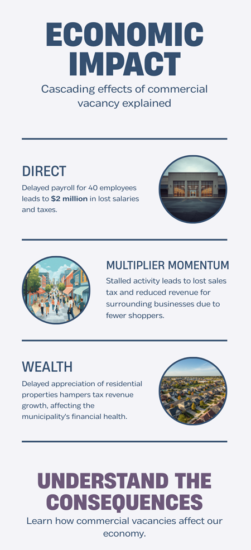
When a major space—say, a former big-box retailer like a Party City—sits dark while a new tenant, like a regional home improvement store, waits to open, the delay creates an immediate, quantifiable economic vacuum.
Let’s use your example to illustrate the staggering cost of a six-to-nine-month delay.
1. The Direct Economic Hit: Payroll and Taxes
The new home improvement store is expected to hire, let’s estimate, 40 employees
- Delayed Salaries: A six-month delay means a half-year lag in those 40 paychecks hitting the local economy. At an average, conservative salary of $50,000, that’s $2 million in delayed payroll .
- Delayed Tax Revenue: This loss of potential wages translates to hundreds of thousands of dollars in lost income tax revenue for local, state, and federal governments—revenue that could have funded critical municipal services.
- Lost Property Income Tax: A commercial property not producing income is valued much lower than one that is. Real estate taxes are based upon the valuation of the property, as the value of the real estate is suppressed, which equates to lost potential real estate taxes that could fund the local economy.
2. The Multiplier Momentum: Stalled Velocity
The most significant loss is the halting of the economic multiplier effect . Every dollar injected into the local economy by a new business is spent again, creating new revenue for other businesses, which pay employees, who then spend their wages… and so on.
- Lost Sales Tax: The 40 new employees would immediately begin spending their $2 million in combined salaries on local services, dining, and merchandise. This spending generates substantial sales tax revenue —tens of thousands of dollars that never reach the municipal coffers.
- Cross-Center Synergy Loss: A new home improvement store is a massive foot-traffic generator. Every week the space sits vacant, the surrounding co-tenants—the coffee shop, the salon, the neighborhood restaurant—lose out on thousands of potential customers who would have otherwise visited the center. This is lost revenue, lost sales tax, and a weakened overall tenant ecosystem.
3. The Neighborhood Wealth Effect: Erosion of Value
Most understand that retail occupancy drives residential desirability. A fully leased, vibrant shopping center acts as an amenity that raises the value of surrounding residential properties.
- Delayed Appreciation & Property Taxes: The moment the store opens and stabilizes the center, the community gains a tangible amenity. This convenience boosts residential property values, leading to a higher wealth effect for homeowners and, critically, higher property tax assessments for the municipality. Every month of delay pushes this wealth creation further into the future.
The Lease-Up Multiplier: Why Speed is the Ultimate ROI
The reverse is the good news: Compressing the time-to-open is the single greatest
return-on-investment (ROI) we can champion right now.
If a community can slash the timeline from 12 months down to 9 months, they are effectively injecting millions in payroll and tens of thousands in sales tax revenue three months earlier. This is the lease-up multiplier in action.
The Municipal Friction Point: A Call for Technology
In my professional opinion, the biggest opportunity for quick acceleration lies in the local municipality’s permit and inspection process. It is time for cities to view their permitting departments not as cost centers, but as economic accelerators .
The best ROI a local government can make today is to invest in technology and expertise to compress their part of the process—from plan review to final inspection—by 50% . This could easily shave three months off the total timeline.
1. AI-Powered Plan Review:
The days of plans sitting on an reviewer’s desk for weeks are rapidly becoming obsolete. The advent of AI and machine learning allows for almost instantaneous, highly accurate code compliance analysis. What may have taken hours can now take minutes. Review comments should be generated, processed, and resubmitted in a matter of days, not weeks.
2. Virtual Inspections & AI Compliance:
Inspection bottlenecks are notorious. New camera technology, coupled with AI, can provide a greater degree of accuracy and reduce time-on-site. Field workers can record video of completed work (plumbing, electrical, structural), and AI can cross-reference the footage against approved plans and building codes in real-time. This creates a permanent, auditable digital record while drastically reducing the need for multiple physical site visits.
The GC & Trade Efficiency: A Shift in Workflow
While municipalities are a key target, the General Contractor (GC) side also offers substantial time-saving opportunities, potentially shaving another two months off the construction build-out.
AI Co-Pilots for the Field:
The next evolution of construction management involves wearable technology and AI co-pilots for field workers. These tools can provide real-time, context-aware guidance, transforming a new hire into an efficient, “master craftsman” capable of immediate problem-solving. This shift leads to:
- Fewer Mistakes: Reduced costly errors and subsequent re-work.
- Fewer Bottlenecks: Real-time visibility and communication for material needs and scheduling.
- Higher Quality of Work: Compliance guided by technology.
The 90-Day Target
If GCs and municipalities embrace these technological workflows, we can bypass the delays associated with plan-checking, inspections, and on-site errors. What would be left to address is primarily logistics and material procurement—a challenge that continues to evolve but is solvable.
I firmly believe that, even with a major build-out, we can realistically return to a time when a new retail business opens its doors in 90 days or less.
Time is capital. The efficiency of our municipal partners and our construction teams has the potential to scale to a magnitude where, if applied across the country, may result in unlocking billions of economic value, tax revenue and local economic health.
The lease-up multiplier is a powerful force, but it remains dormant until the tenant opens. The mandate for the industry now is to advocate, invest, and lead the charge in technological adoption to get our tenants trading—and our communities thriving—faster.
Related Articles
- Release Notes : November 2025 DMM shopping center and tenant data
- Qualifying the Income in a Retail Property Acquisition
- How to convince a retailer your shopping center is the right location to open a store
- What Do CAM and Taxes Run at Open-Air Shopping Centers These Days?

Hue Chen, President of Saglo Companies
Hue Chen has been in the retail shopping center industry since the year 2000 and has been involved in all aspects of the business from leasing to operations to capital markets. His objective as President of Saglo Companies, an owner-operator of retail properties, is to scale the company’s portfolio and operations while maintaining strong performance for its investors.
As a strong believer that the retail asset class is one of the most dynamic and relationship-driven arenas in commercial real estate, Hue emphasizes building a strong internal culture grounded in service, accountability, and operational excellence. He works closely with Saglo’s team to elevate tenant experience, enhance asset performance, and strengthen investor confidence.
Hue lives in Fort Lauderdale with his wife, Nicole, and enjoys practicing his Christian faith, traveling—especially to Taiwan—and exploring emerging technologies.